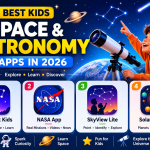
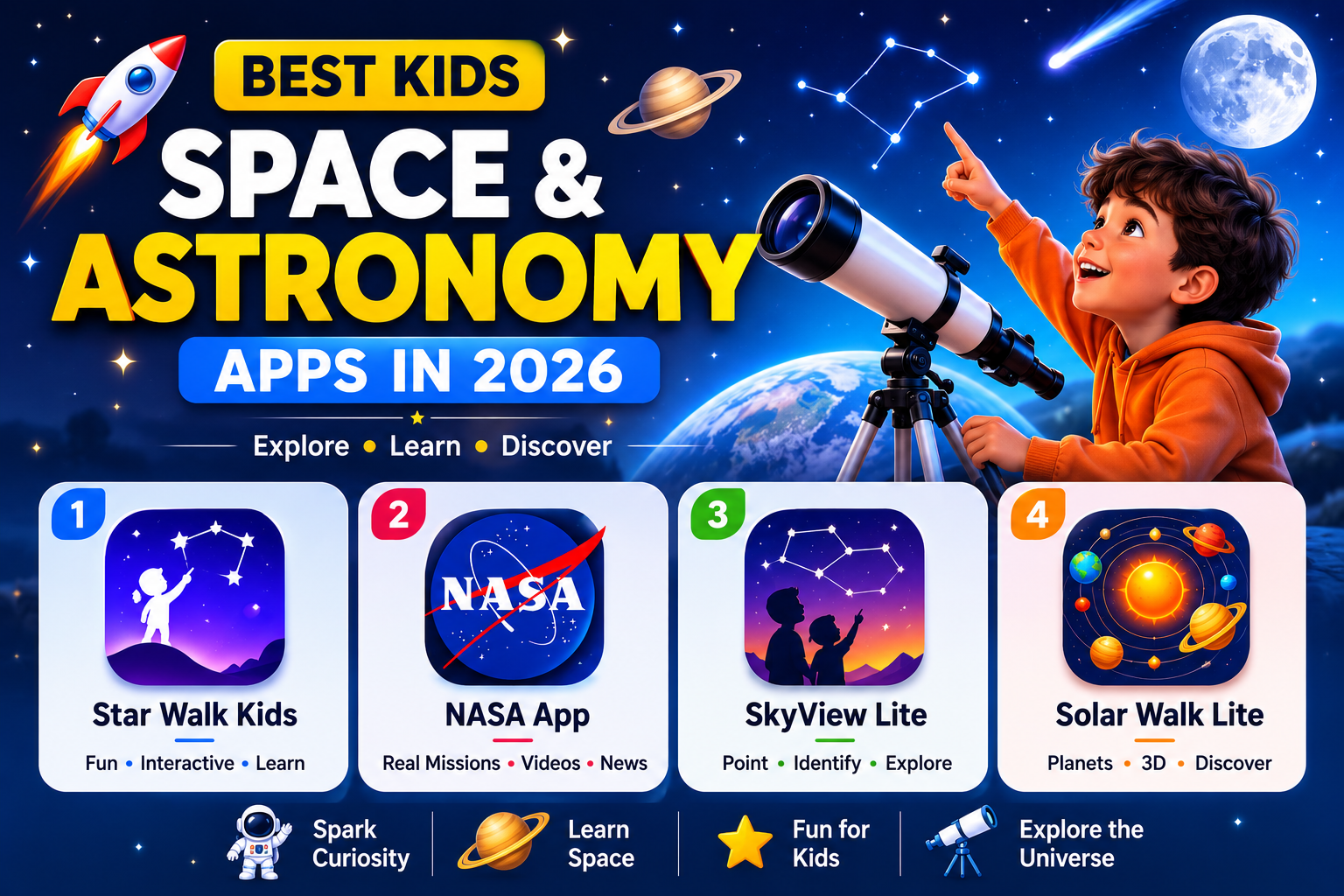
Few topics grab a child’s imagination quite as reliably as outer space, and a strong lineup of astronomy apps has turned that natural curiosity into something a family can actually explore together, whether that’s identifying a constellation by simply pointing a phone at the night sky or taking a guided tour of the solar system from a tablet on the living room couch. The best apps in this category combine genuine scientific accuracy, using real NASA and ESA data for their celestial positions and imagery, with presentation genuinely built for young kids rather than dense reference material repurposed for adults. Here’s a look at the space and astronomy apps worth downloading for a curious young learner this year.
Star Walk Kids
Star Walk Kids adapts the acclaimed adult Star Walk app specifically for children, replacing technical astronomy language with narrated explanations, animated constellation characters, and simple touch interactions built for kids as young as four. A step-by-step learning structure introduces planets gradually rather than all at once, with the app tracking a child’s progress and revisiting material as needed rather than assuming everything sticks the first time through. Short self-check quizzes after each lesson let kids test what they’ve learned, and every celestial object remains positioned accurately for the child’s real time and location, so pointing the device at the actual night sky shows exactly what’s really there.
View on Play Store | View on App Store
NASA App
NASA’s official app remains one of the best free educational resources available for space-curious kids and families alike, delivering daily mission updates, high-resolution telescope imagery, and access to NASA+ video streaming without any ads or in-app purchases getting in the way. It includes real-time International Space Station tracking with viewing opportunity alerts, letting families step outside and actually spot the station passing overhead, connecting the app directly to a real, observable event rather than keeping everything on a screen. Interactive augmented reality experiences let kids explore spacecraft and mission hardware up close, adding a hands-on dimension that pure video or images can’t quite match.
SkyView Lite
SkyView Lite uses augmented reality to identify stars, planets, constellations, and satellites in real time simply by pointing a phone or tablet at the sky, day or night, and has been downloaded more than 40 million times since its release. Beyond basic identification, it covers all 88 official constellations along with the zodiac constellations, and tapping any object pulls up detailed information including its brightest star, family, and origin story, giving curious kids a natural next question to explore after spotting something interesting overhead. Its Sky Paths feature tracks the daily movement of the sun and moon, helping kids build an intuitive sense of how objects move across the sky over the course of a day.
Solar Walk Lite
Solar Walk Lite turns a device into an interactive pocket planetarium, offering a genuinely detailed 3D model of the solar system with real-time positions of every planet and major celestial body, all built on scientific data collected by NASA and ESA spacecraft. Kids can zoom into individual planets to explore their internal structure and see real photographs captured by space telescopes and probes, and an Orrery Mode toggle switches between realistic scale and a simplified schematic view that makes the relative distances between planets easier to grasp. Completely free with no in-app purchases and no internet connection required once downloaded, it works reliably as an offline reference for road trips or anywhere a family might not have reliable data.
These four apps work well together rather than competing directly, since each covers a slightly different piece of the astronomy experience. Star Walk Kids is the best starting point for the youngest learners thanks to its narrated, story-driven approach, while SkyView Lite and the NASA app work well for slightly older kids who are ready to point a device at the real sky and start identifying what’s actually up there. Solar Walk Lite rounds things out as the deepest dive into the solar system specifically, making it a natural next step once a child has moved past basic constellation spotting and wants to understand what the planets themselves are actually like.
Conclusion
Astronomy remains one of the most naturally engaging entry points into science for young kids, and this year’s crop of space apps does a genuinely good job of channeling that curiosity into something educational rather than just another screen distraction. Whether the first step is spotting a familiar constellation from the backyard or taking a virtual tour past Saturn’s rings, these apps make it easy for a family to turn an ordinary evening into a small astronomy lesson.