Maths anxiety affects children from as early as six years old and often develops from negative early experiences with number work. The best maths apps for primary school kids in 2026 take a different approach from drill-and-repeat worksheets – they embed curriculum-aligned maths practice in game environments where wrong answers are learning moments rather than failures. These apps were reviewed with children across the full primary school age range from four to twelve years old over a minimum of four weeks of regular use.
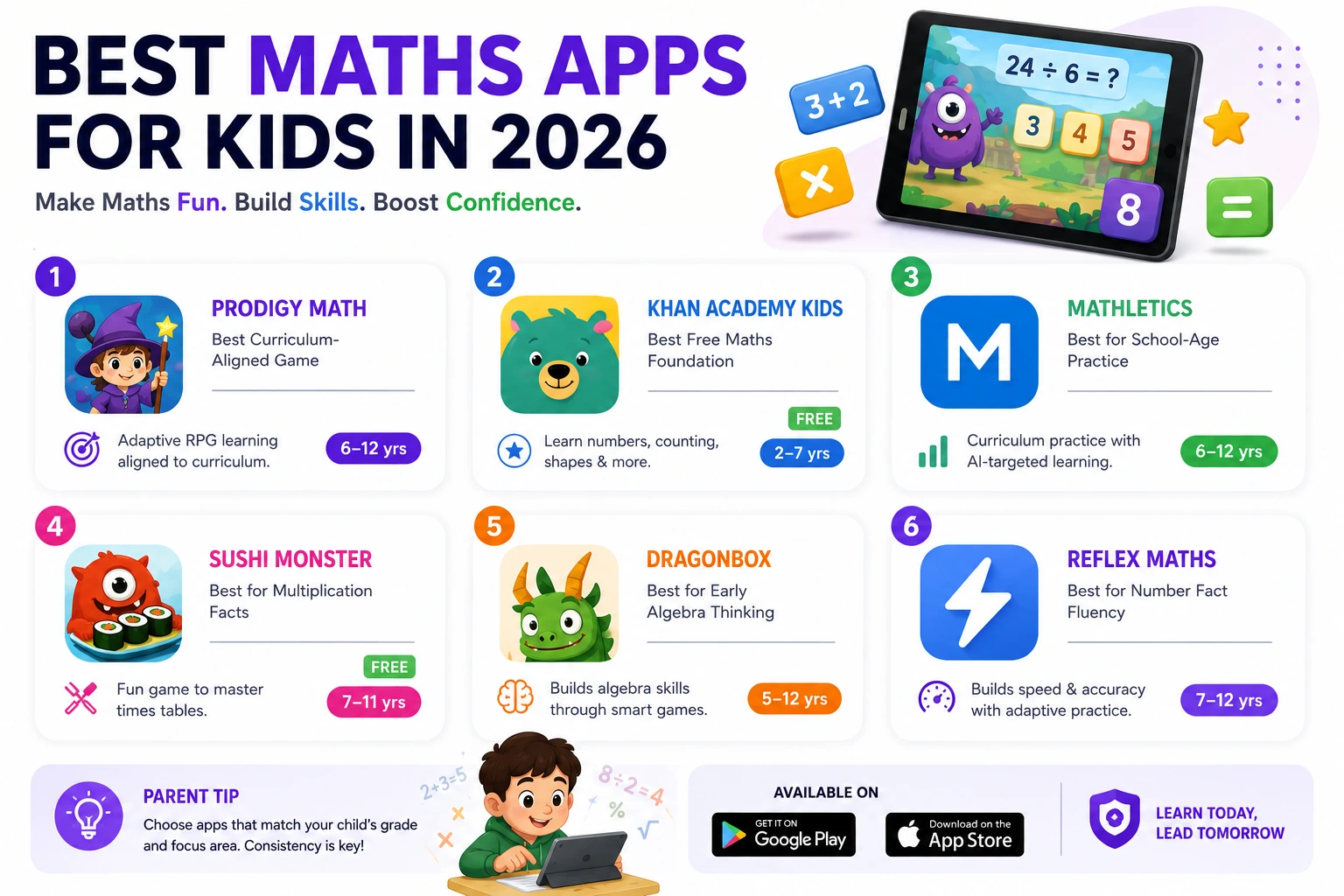
1. Prodigy Math – Best Curriculum-Aligned Maths Game
Prodigy wraps maths practice inside a fantasy RPG where answering maths questions powers your character’s abilities in battles. The questions are curriculum-aligned to national standards in over thirty countries and the adaptive algorithm adjusts difficulty based on the child’s demonstrated performance, ensuring they are always working at the edge of their current ability rather than reviewing content they already know or being presented with material they are not ready for.
The depth of the maths content is impressive – Prodigy covers number sense, operations, fractions, geometry, measurement, and data analysis across the full primary range. The game integration is sophisticated enough that children report enjoying the maths component rather than tolerating it to reach the game parts. Free core gameplay with a parent subscription unlocking detailed progress reports and learning objective tracking.
2. Khan Academy Kids – Best Free Maths Foundation
Khan Academy Kids covers maths from early counting and number recognition through addition, subtraction, and basic geometry in a completely free, advertisement-free environment. The lessons are built around Kodi the bear and a cast of animal characters who guide young learners through activities that blend maths with reading and creative development.
The adaptive learning engine means each child’s experience is personalised to their current level without any parent configuration required. Best for children aged two to seven building their maths foundation. The absence of any cost or in-app purchase pressure makes it the default recommendation for parents who are cautious about app spending.
3. Mathletics – Best for School-Age Maths Practice
Mathletics is the most widely used maths platform in primary schools globally and the home version mirrors the curriculum coverage that classroom teachers use. The platform covers every maths topic from year one through year six with structured activities, fluency drills, and problem-solving challenges. The competitive element – earning points that place children on global leaderboards against peers at the same curriculum level – motivates consistent practice without creating unhealthy pressure.
The 2026 update added AI-generated targeted practice sessions that identify the specific concepts a child is getting wrong and provide focused practice on those topics specifically. For children preparing for standardised assessments or catching up after missed learning, this targeted practice is more efficient than general practice across all topics.
4. Sushi Monster – Best for Multiplication and Division Facts
Sushi Monster from Scholastic is specifically designed to build multiplication and division fact fluency through an engaging restaurant game mechanic. A monster orders sushi and children must make the correct number using the available ingredients, reinforcing fact families through repeated practice that feels like play rather than drilling.
The game design is genuinely smart – it is not just flashcard practice with a different skin but a mechanic that requires children to think about numbers in terms of their relationships and factors rather than just memorising isolated facts. For children in years three to five working on multiplication tables, Sushi Monster is the most effective fact-fluency app available. Completely free.
5. DragonBox – Best for Building Algebraic Thinking Early
DragonBox takes a remarkably clever approach to early algebra – it teaches children the logic of equation balancing through a game involving a dragon in a box without using any algebraic notation. Children as young as five can play through DragonBox Numbers and DragonBox Algebra 5 Plus, building the conceptual understanding of algebraic relationships that secondary school maths later formalises with symbols.
Research studies have demonstrated that children who play DragonBox show improved algebraic reasoning performance even without explicit algebra instruction. The game-first approach works because it builds genuine understanding of mathematical relationships rather than procedural rule-following. Paid apps with no in-app purchases.