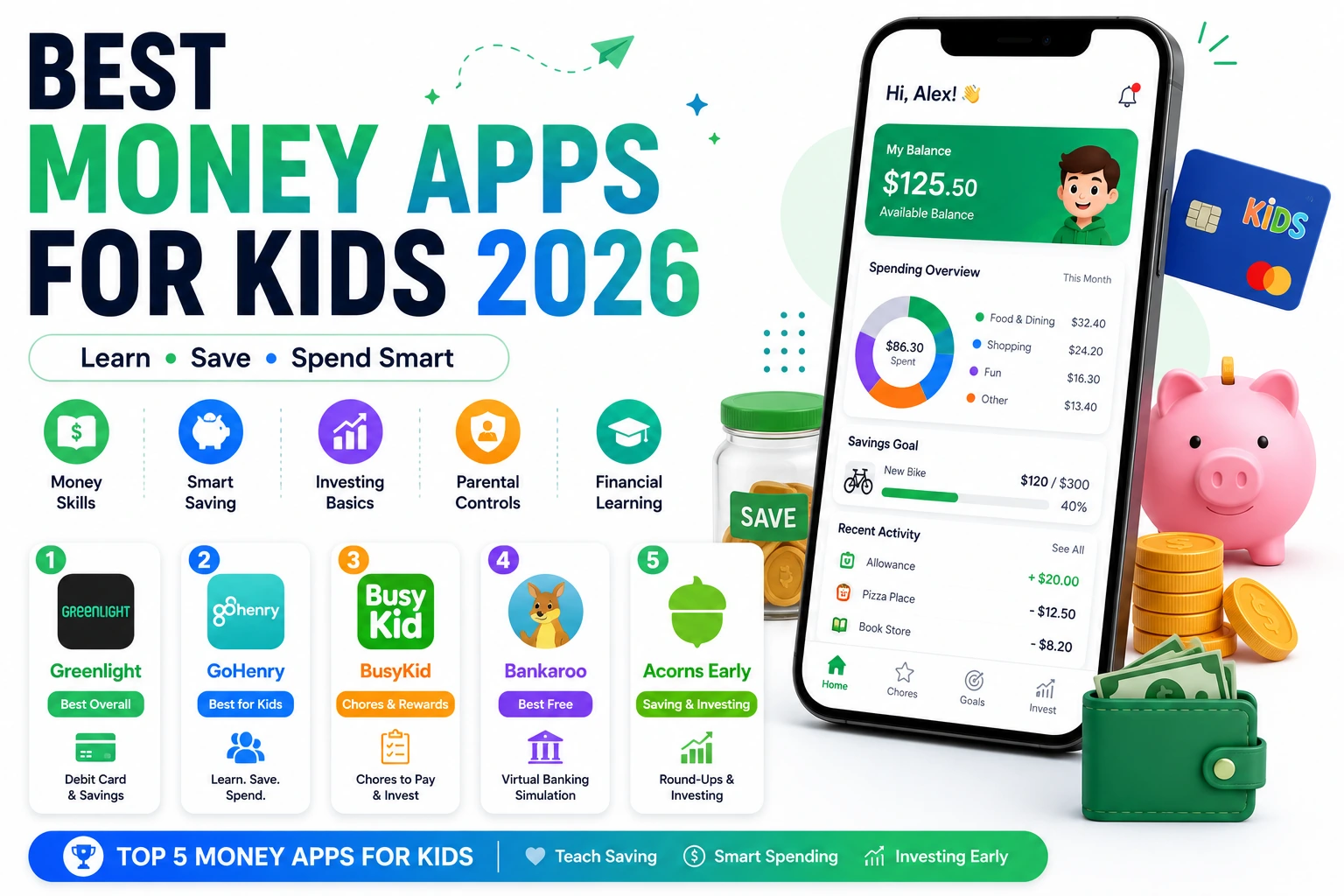
Financial literacy is one of the most important life skills that traditional schooling often fails to teach adequately. Children who grow up understanding how saving, earning, and spending decisions work tend to make better financial decisions as adults. In 2026, a strong ecosystem of apps designed specifically for teaching kids about money has emerged, ranging from simple allowance trackers to full debit card products with parental controls. These five apps were evaluated for educational value, age-appropriateness, and engagement across families using them for a minimum of one month.
Greenlight – Best Debit Card and Money App for Kids
Greenlight provides a real debit card for kids and teens with full parental control over spending categories, store-specific restrictions, and real-time spending notifications. Parents can set up automatic allowance payments, create savings goals with visual progress tracking, and even pay interest on savings to teach the concept of compound growth in a tangible way that children can directly observe.
The Investing feature allows teens to invest in real stocks and ETFs with parental oversight and approval requirements, providing hands-on experience with investing concepts before they become financially independent adults. The chores feature ties earning directly to completed tasks, reinforcing the connection between work and income that is fundamental to financial literacy. Greenlight costs four dollars and ninety-nine cents per month for the family plan covering up to five children.
Visit www.greenlight.com
GoHenry – Best for Younger Children
GoHenry is designed specifically for children aged six to eighteen with a money card and app that introduces financial concepts through a simplified, age-appropriate interface. The Money Missions feature delivers short interactive lessons covering earning, saving, spending, and giving that build foundational financial literacy concepts through engaging activities rather than passive reading.
Parents control spending limits, can block specific merchant categories, and receive instant notifications for every transaction. The earning system through configurable chores teaches the connection between effort and income from an early age. GoHenry’s emphasis on teaching the giving concept alongside saving and spending creates a more complete financial values framework than apps that focus exclusively on personal accumulation.
Visit www.gohenry.com
BusyKid – Best for Connecting Chores to Pay
BusyKid centres its entire model around the chore-to-payment connection, with a digital chore chart that parents customise with specific tasks and pay rates. When children complete chores, earnings flow into their digital account where the app automatically splits the money across spending, saving, donating, and investing categories based on percentages parents configure.
The automatic allocation across these four categories is BusyKid’s most pedagogically valuable feature – it builds the habit of dividing income purposefully across different financial goals rather than treating all money as available for immediate spending. The investing feature allows purchasing fractional shares of real stocks, giving children direct ownership experience in companies they recognise and are interested in.
Visit www.busykid.com
Bankaroo – Best Free Virtual Banking Simulation
Bankaroo provides a completely virtual banking simulation without any real money or debit card – making it ideal for younger children or families who want to teach concepts before introducing real spending power. Children manage virtual checking and savings accounts, set savings goals with visual trackers, and learn to read simple financial statements showing their virtual transaction history.
Because there is no real money involved, Bankaroo is appropriate for children as young as five or six who are just beginning to understand the concept of money and saving. The completely free model makes it accessible to any family regardless of budget, and it serves as an excellent introduction before transitioning to a real card-based product like Greenlight or GoHenry as children get older.
Visit www.bankaroo.com
Acorns Early – Best for Long-Term Saving Habits
Acorns Early is a custodial debit card and money management app from the investing company Acorns, integrating their well-known approach to micro-saving with a kids and teens product. The card encourages automatic round-up saving on purchases – a small amount from each transaction automatically transfers to a savings account, teaching the habit of consistent saving without requiring conscious decision-making for each contribution.
The financial education content within the app is integrated with Acorns’ broader educational resources, connecting kids’ money habits with the same investing philosophy that has made Acorns popular with adult users. For families already using Acorns for their own investing, extending the family relationship to a kids product creates a unified financial education approach across the household.
Visit www.acorns.com
Choosing the Right Money App for Your Child’s Age
For children aged five to eight who are just learning what money is: start with Bankaroo’s free virtual simulation before introducing real spending power. For children aged eight to fourteen ready for real money management with strong parental oversight: GoHenry or Greenlight provide the most comprehensive feature sets with age-appropriate interfaces. For teenagers ready to learn investing alongside spending and saving: BusyKid or Acorns Early introduce real investment concepts that prepare them for adult financial independence.