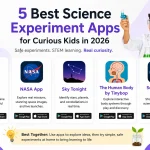
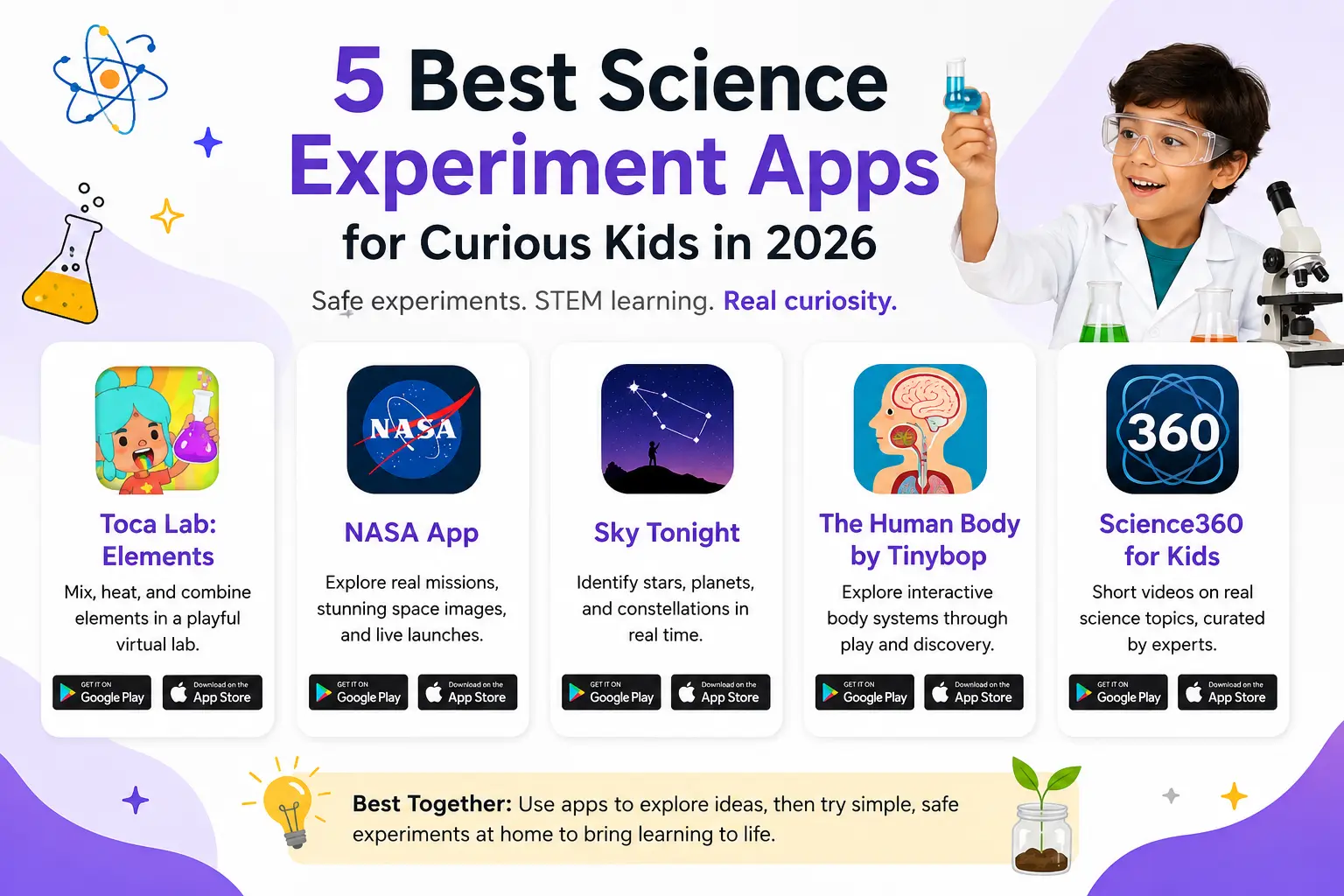
Kids who ask ‘why’ about everything are usually just waiting for a safe way to actually test their questions, and science apps have gotten genuinely good at giving them that outlet without needing a fully stocked home lab or constant adult supervision. The best ones don’t just present facts to memorize, they simulate real experiments and let kids change variables and see what happens, which builds actual scientific thinking rather than passive consumption. That kind of active, hands-on curiosity tends to stick with kids far longer than anything read from a textbook alone. Here are five science experiment apps in 2026 that turn natural curiosity into hands-on, screen-based learning kids genuinely enjoy coming back to.
Toca Lab: Elements
Toca Lab turns the periodic table into a playful virtual laboratory where kids can heat, freeze, and combine elements to see their real-world reactions and properties, all wrapped in Toca Boca’s signature charming, low-pressure art style. It’s a genuinely clever way to introduce chemistry concepts years before they’d formally encounter them in school.
NASA App
The official NASA app gives kids access to real mission updates, stunning space imagery, and live launch streams, turning space curiosity into direct engagement with actual ongoing science rather than simplified textbook summaries.
Sky Tonight
Sky Tonight uses a phone’s camera and sensors to identify stars, planets, and constellations in real time just by pointing the device at the night sky, turning a simple evening walk into a genuine astronomy lesson.
The Human Body by Tinybop
This app lets kids explore an interactive model of the human body, tapping through systems like digestion and circulation to see how they actually function together, with an approach that favors genuine exploration over guided lessons.
Science360 for Kids
Backed by the National Science Foundation, this app curates short, genuinely well-produced videos covering everything from ocean biology to robotics, giving curious kids a safe, ad-free way to go down real science rabbit holes.
Pairing Apps with Real Hands-On Experiments
Science apps work best as a companion to real-world experiments rather than a full replacement for them, since actually mixing baking soda and vinegar or growing a bean plant on a windowsill builds a kind of tactile understanding no screen can fully replicate. Use an app like Toca Lab to introduce a concept safely, then follow it up with a simple, genuinely safe kitchen experiment that puts the same idea into physical practice, the combination reinforces learning far better than either approach alone. Many science apps also include suggested offline activities directly in their design, so check for that feature specifically if you want a tool that actively encourages stepping away from the screen rather than keeping kids glued to it indefinitely.
The goal of a good science app isn’t to replace curiosity with entertainment, it’s to give that curiosity somewhere safe and engaging to go until a real lab, classroom, or backyard experiment can take over. Start with whichever app matches what your child is already asking about, whether that’s space, the human body, or chemistry, and let their specific questions guide which of these five is worth downloading first. Checking in occasionally to ask what they discovered also turns a solo screen activity into a shared conversation, which tends to deepen the learning far more than leaving them to explore entirely alone, and it gives you a natural window into what genuinely excites them.