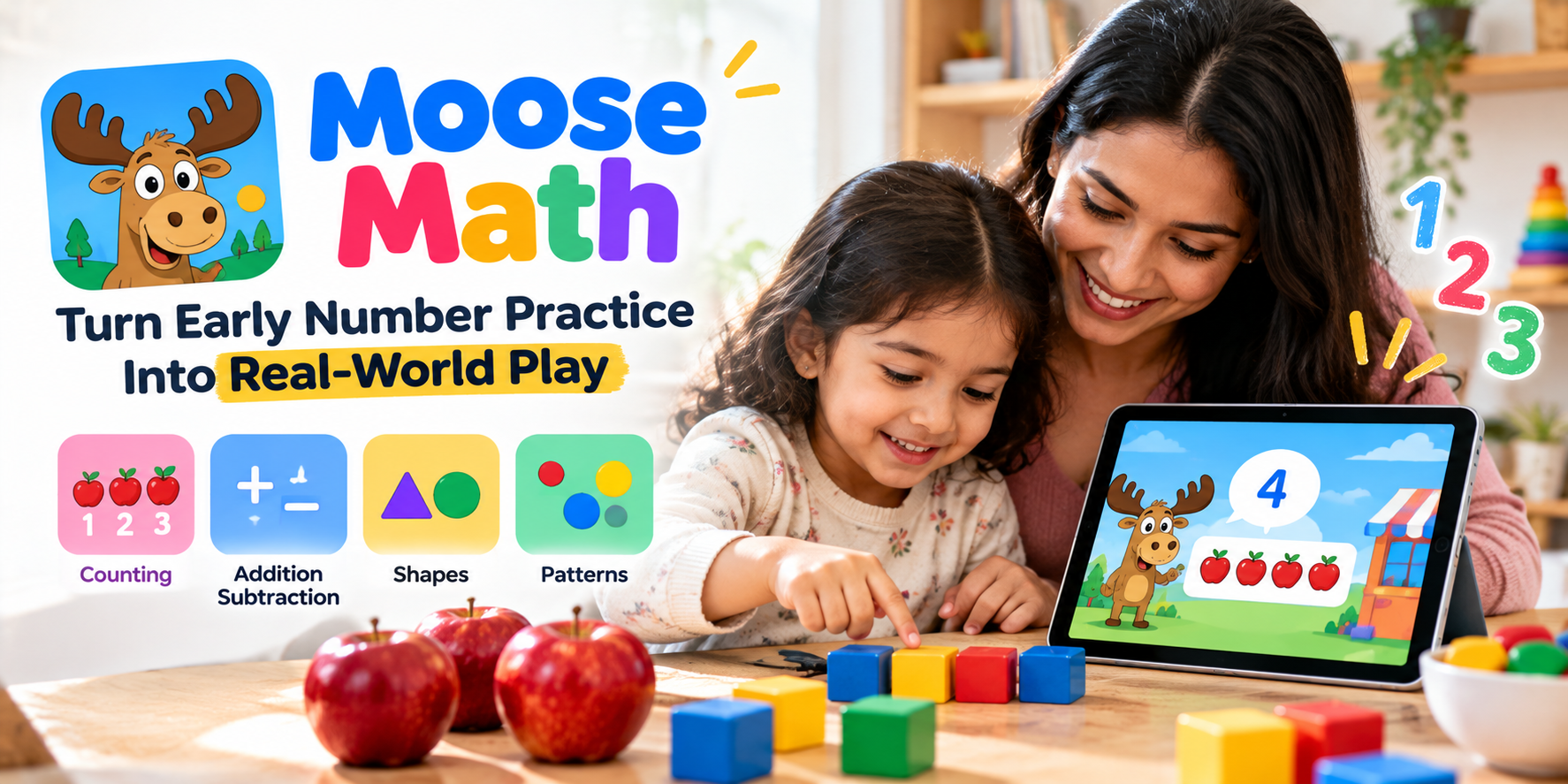
Early mathematics is much broader than reciting numbers. Children compare sizes, notice repeating patterns, sort objects and discover that adding one item changes a group. Moose Math introduces several of these ideas through five colourful activities aimed at preschool and early-primary learners.
Created by Duck Duck Moose, now part of nonprofit Khan Academy, the app is available free on Android, iPhone and iPad. Google Play lists it for ages three to eight, while Apple describes it for ages three to seven. There are no subscriptions or third-party advertisements. Apps on Google Play
Five activities, several kinds of maths
In Moose Juice, children prepare imaginary smoothies while practising counting, addition and subtraction. Paint Pet asks them to match pets by counting dots, while Pet Bingo turns number problems into a bingo game. Lost & Found focuses on sorting shapes and colours, and Dot to Dot introduces number sequences.
The activities collectively cover counting to 100, skip-counting, addition and subtraction up to 20, patterns, geometry and comparisons involving length. The content was designed around US Common Core standards for kindergarten and first grade, so its sequence may not match every child’s school curriculum exactly. Apps on Google Play
Parents should therefore treat the app as practice rather than as a complete mathematics course or an assessment of school readiness.
Use the report card carefully
Moose Math includes a report-card section showing the skills a child has practised. That can help an adult notice whether the child is comfortable with counting but uncertain about subtraction or sorting.
The report should begin a conversation, not become a scorecard. If a child repeatedly struggles, sit beside them and ask how they are thinking. They may misunderstand an instruction, have difficulty controlling the screen or simply be tired. Repeating a level until the app records success does not necessarily mean the underlying idea is understood.
Short sessions can keep the experience playful. Ending after one or two activities may be more useful than asking a young child to complete every available challenge.
Carry the maths into daily life
The best follow-up requires no additional app. After making virtual smoothies, count pieces of fruit in the kitchen. Sort socks by colour or size after playing Lost & Found. Make a repeating pattern with spoons and cups, or ask how many plates are needed if one more person joins dinner.
The National Association for the Education of Young Children notes that ordinary routines—including cooking, dressing and shopping—offer opportunities to count, sort, compare, measure and notice patterns. Talking about these ideas helps children connect screen-based symbols with physical objects and real quantities. NAEYC
Know the practical limitations
The current store listings describe Moose Math as English-only. Children who do not yet understand its spoken or written instructions may need an adult nearby, even when they understand the mathematical task.
Duck Duck Moose says its children’s apps do not require personal information and collect only limited, non-personal usage information. Google Play similarly states that the app contains no third-party advertising or personal-information collection. However, the linked Duck Duck Moose privacy policy was last updated in 2016, so parents should compare it with current store disclosures before installation. Apps on Google Play
Moose Math remains appealing because it is focused, free and easy to sample. Used alongside blocks, household objects, conversation and school instruction, it can give young children a cheerful place to practise—not a reason to keep mathematics confined to a screen.
Sources
- App URL: Moose Math
- App Developer URL: Duck Duck Moose
- Parent Organisation: Khan Academy
- Android: Moose Math on Google Play India
- iPhone and iPad: Moose Math on the App Store India
- Privacy Policy: Duck Duck Moose Privacy Policy
- Supporting reference: NAEYC: Maths Learning for Families