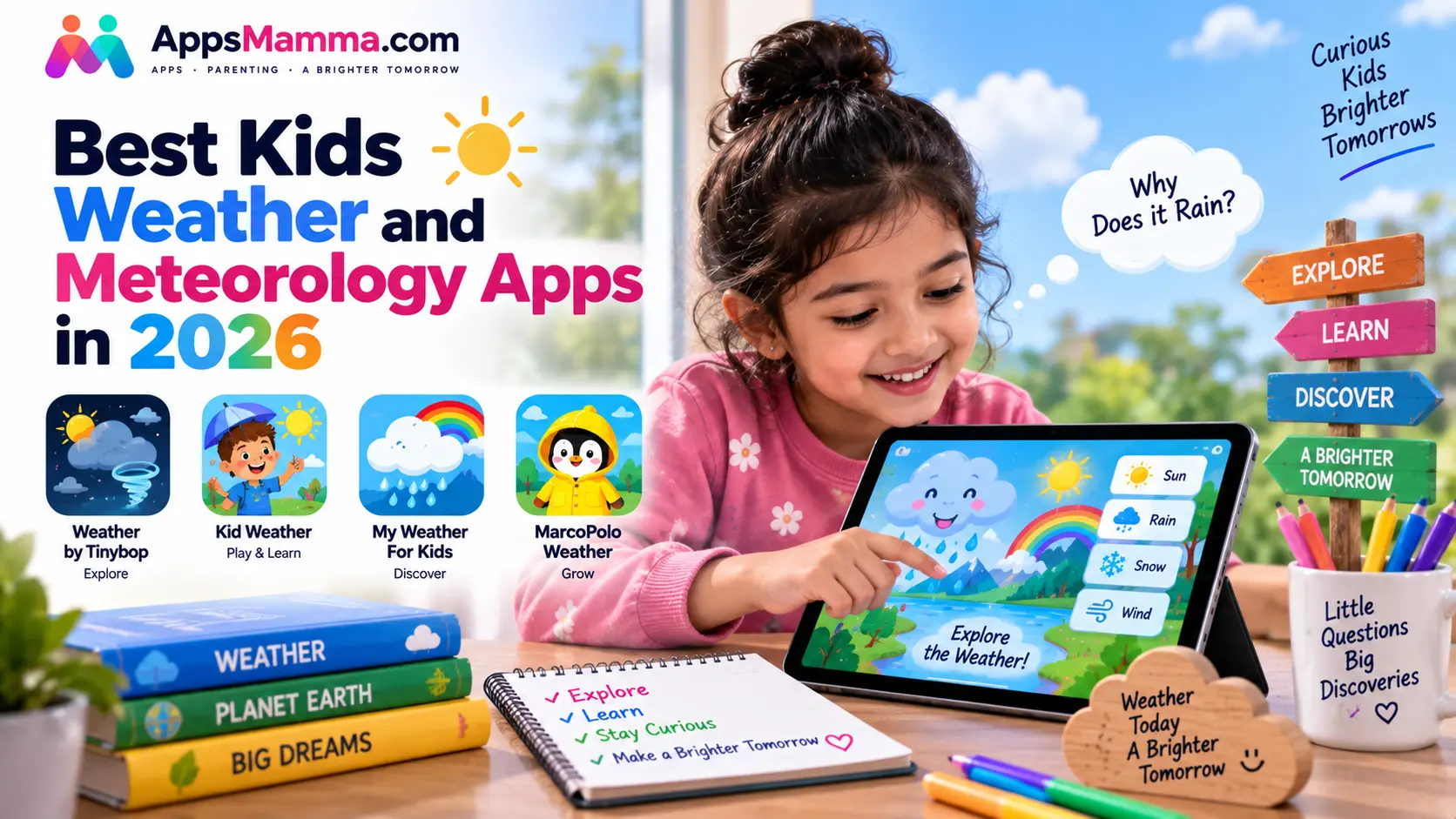
Weather naturally sparks endless questions in young kids, why does it rain, what makes a tornado spin, why is snow cold but clouds look soft, and a strong lineup of apps has grown up specifically to turn that natural curiosity into genuine meteorology learning rather than leaving questions unanswered. The category splits into a few distinct approaches worth understanding: interactive science models kids can manipulate directly, practical everyday forecast apps built specifically for a young audience, and games that teach weather-appropriate decision-making. Here’s a look at what’s worth using this year.
Weather by Tinybop
Weather by Tinybop offers a genuinely interactive meteorology model rather than a passive lesson, letting kids dive into a cloud to see what it’s made of, make it rain or snow, whirl a tornado or hurricane, and play directly with the underlying forces, sun, air, water, temperature, wind, and precipitation, that actually create weather. Designed for curious kids ages four and up as part of Tinybop’s award-winning Explorer’s Library series, it has won recognition including App Store Editors’ Choice and Parents’ Choice awards for its combination of genuine scientific accuracy and hands-on interactivity. Its included Weather Handbook supports STEM education directly with fun facts and discussion questions, making it a genuinely strong classroom or homeschool companion beyond pure app play.
Kid Weather
Kid Weather was designed by a six-year-old boy and his meteorologist father, delivering real-time weather conditions and forecasts through an eye-catching kid or animal avatar that dresses appropriately for whatever the actual weather conditions happen to be. Its interactive Wear? feature lets kids change the weather themselves, raising or lowering temperature, making it sunny, rainy, or snowy, and watching how the avatar’s clothing changes in response, building an intuitive connection between conditions and appropriate dress. Educational content including trivia, safety tips, and extreme weather records rounds out a genuinely STEM-minded app built with both parents and teachers specifically in mind.
My Weather – For Kids
My Weather – For Kids, also known as Meteorology for Kids, uses engaging illustrations and randomly appearing facts to teach weather phenomena, letting kids create their own weather scenarios and learn specifically how thunderstorms actually occur. Its content is specifically designed to be revisited multiple times, since randomized facts mean checking each topic more than once reveals genuinely new information rather than repeating the exact same content every session. Its explicit design for use in kindergartens and schools, alongside home use, gives it a genuinely structured educational foundation beyond simple entertainment.
MarcoPolo Weather
MarcoPolo Weather takes a more playful, character-driven approach specifically for younger kids, using a whimsical dress-the-character game to teach basic temperature and weather concepts that some kids genuinely struggle to grasp from verbal explanation alone. Its approach directly addresses a common parenting frustration, a child insisting it’s warm outside despite being told otherwise, by letting kids directly experience and interact with different weather conditions and see the practical, visual consequences of each. For the youngest weather-curious kids who aren’t yet ready for a deeper scientific model, its simpler, more playful format offers a genuinely appropriate entry point.
Matching the app to a child’s age and how deep their curiosity actually runs matters more than picking a single best option. The youngest kids just building basic weather intuition, understanding that rain means wet and snow means cold, will do well with MarcoPolo Weather’s simple, playful dress-the-character format. Slightly older kids ready for genuine hands-on science exploration should move toward Weather by Tinybop’s interactive meteorology model, and kids who enjoy checking in on real, practical daily forecasts alongside educational content will get the most consistent engagement from Kid Weather or My Weather – For Kids, both built specifically to be revisited regularly rather than used once and forgotten.
Conclusion
Weather remains one of the most naturally engaging entry points into real science for young kids, and 2026’s strongest weather apps have gotten genuinely skilled at channeling that curiosity into lasting meteorology understanding rather than leaving questions unanswered. Whichever of these four ends up fitting a particular child’s age and interests, the underlying payoff remains the same: turning a rainy afternoon’s questions into a genuine, lasting fascination with how the sky actually works.