Fractions are the point where math stops feeling intuitive for many children. Whole numbers behave predictably, but suddenly a bigger denominator means a smaller piece, and the rules seem arbitrary. Researchers and teachers often stress that fraction understanding is built on a sense of magnitude, knowing roughly how big three-quarters is, rather than on memorized procedures. The best apps respect that, using puzzles, movement, and visual models to make parts of a whole feel concrete. One practical caution: some older educational apps are rarely updated, so check the last update date and device compatibility before buying. Here are four worth considering this year.
Slice Fractions
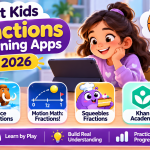
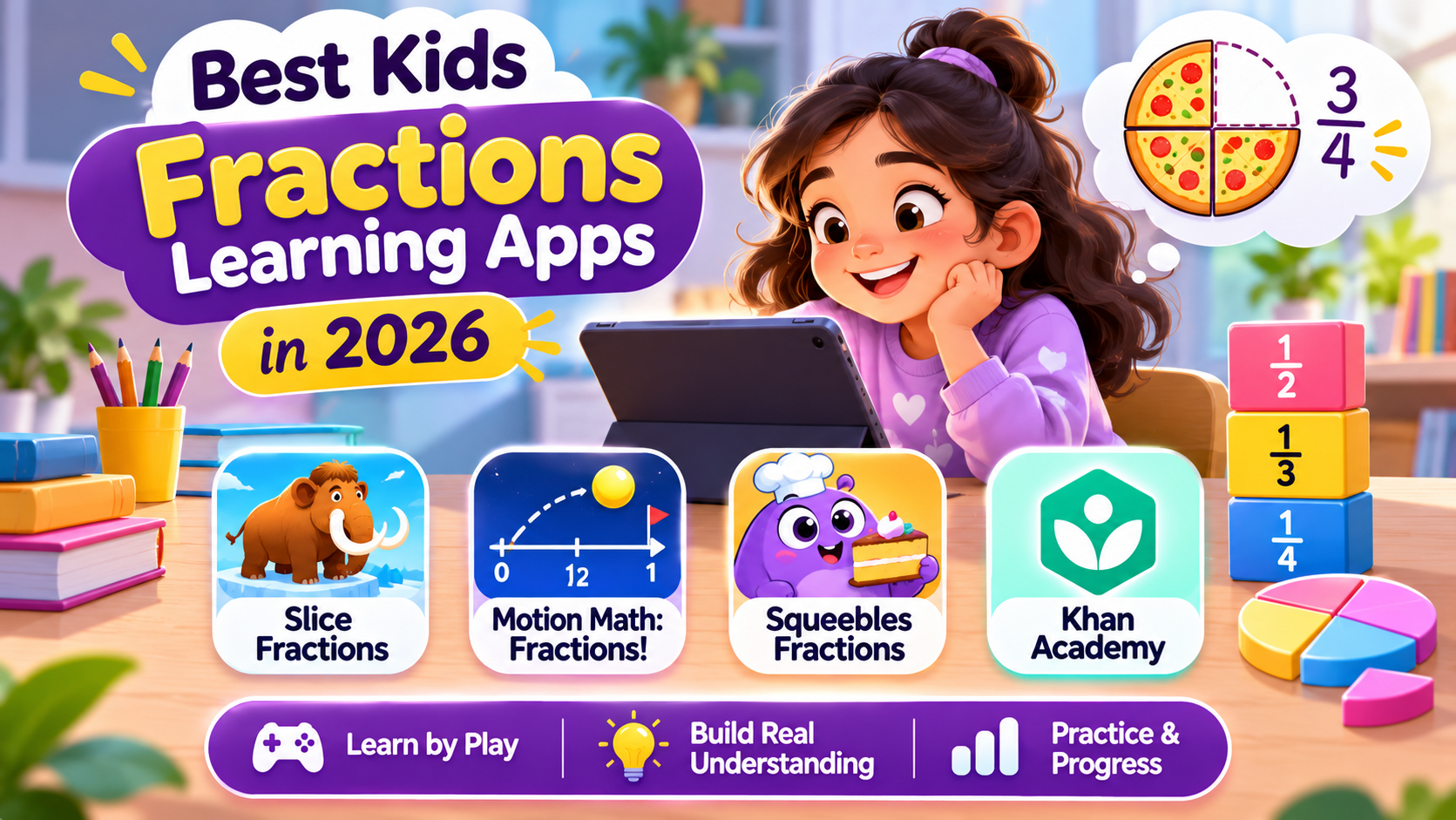
Slice Fractions, from developer Ululab, remains the benchmark for conceptual fraction learning. Kids slice through ice and lava to clear a path for a mammoth, and the puzzle mechanics themselves teach fractions without using any words. It was named a Best of 2014 pick and an Apple Editors’ Choice, and reviewers have praised how much deeper the learning runs than the cartoon premise suggests. It suits roughly ages six to twelve, and a sequel, Slice Fractions 2, covers complementary concepts. Both are sold as one-time purchases on the App Store and Play Store rather than as subscriptions, which many parents appreciate. For children who learn by doing rather than by instruction, it is the strongest place to start.

Motion Math: Fractions!
Motion Math: Fractions! uses the device’s tilt sensor to turn estimation into a physical game. Children tilt the screen to guide a bouncing ball toward the right spot on a number line, working out where fractions like three-quarters or two-fifths belong. That repeated placement builds exactly the magnitude sense that later arithmetic depends on. It is limited by design: it does not cover adding, subtracting, or equivalent fractions, so it works best as a companion to a broader app rather than a complete course. It is aimed at older elementary children and has been available on iOS.
Squeebles Fractions
Squeebles Fractions wraps practice in a friendly bakery theme. Children recognize fractions, match equivalents, and add fractions using cakes divided into pieces from halves up to twelfths, with cheerful characters guiding each round. It is a good fit for kids who need repetition but get bored by plain worksheets, and the visual cakes keep the idea of equal parts front and center. As with other long-running apps, it is worth confirming that it is current and compatible with the device before purchasing. For younger learners who respond to colorful, character-led practice, it offers an approachable path.
Khan Academy
Khan Academy offers something different from the game-based apps: a structured, free curriculum with video explanations, practice exercises, and progress tracking across fractions and the rest of elementary and middle school math. It adds the step-by-step instruction that puzzle games deliberately avoid, which makes it useful for review, homework support, or filling specific gaps. The tradeoff is that it is a curriculum rather than a game, so children who are motivated mainly by play may find it less engaging than Slice Fractions or Motion Math. Used together, a game to build intuition and Khan Academy to practice procedures make a strong pairing.

Matching the app to the stage a child is at matters more than picking one winner. Children meeting fractions for the first time, or those who feel they are guessing, will gain the most from Slice Fractions’ wordless, puzzle-based introduction. Motion Math adds focused practice on where fractions sit on a number line, and Squeebles suits younger learners who like repetition delivered in a playful wrapper. When it is time to learn procedures, such as finding common denominators, a structured curriculum like Khan Academy fills the gap games leave. Short, regular sessions of ten to fifteen minutes are usually more effective than occasional long ones.
Conclusion
Fractions do not have to be the moment a child decides they are not a math person. With apps that build a feel for parts and wholes before introducing procedures, the topic becomes far less intimidating. Whichever combination suits a particular child, the goal is the same: real understanding that carries forward into decimals, percentages, and algebra.