
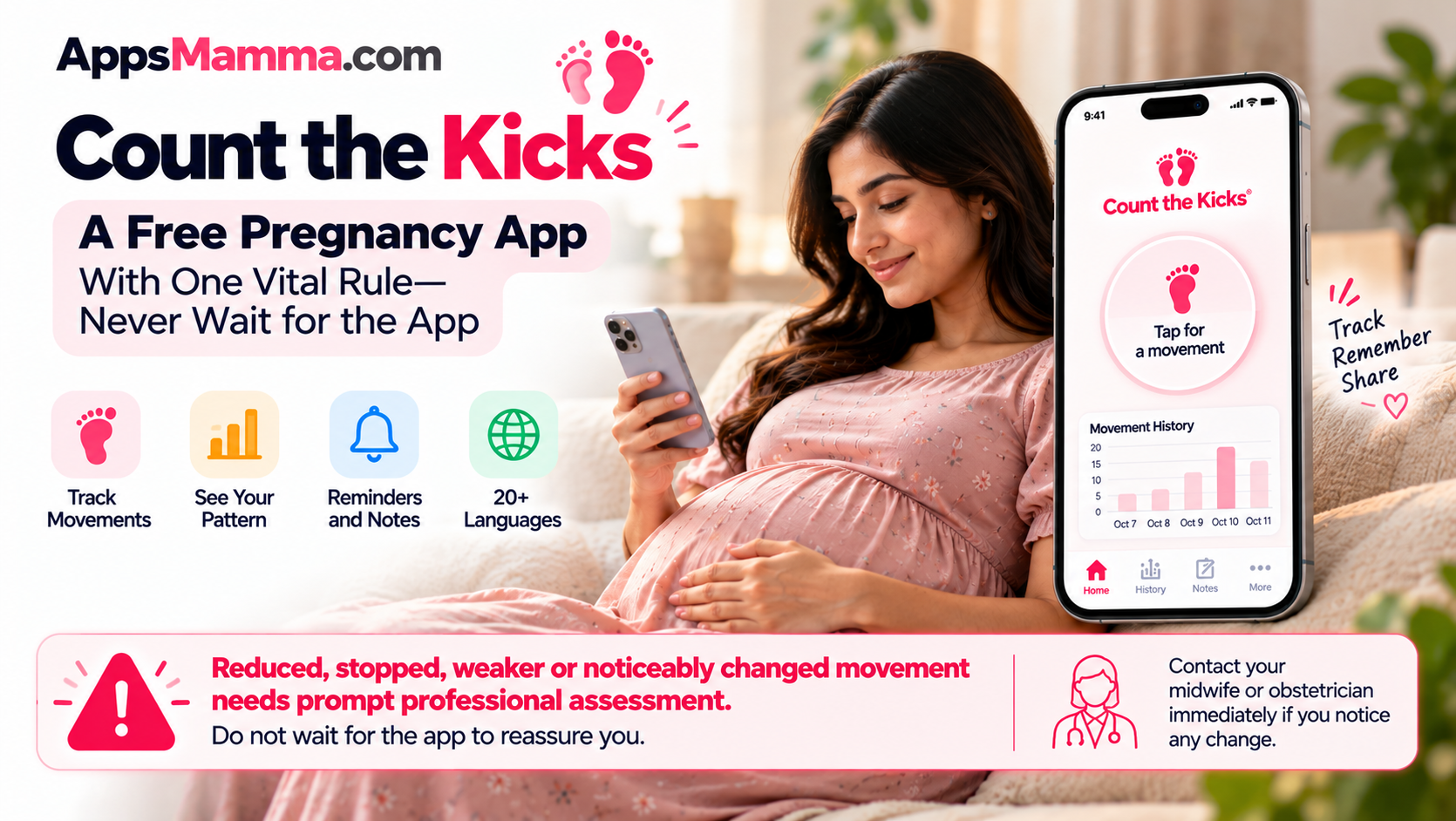
Fetal movement can feel both reassuring and difficult to describe. One day may include strong rolls; another may seem quieter. Count the Kicks gives expectant parents a structured way to record those observations during the third trimester and identify changes in their baby’s usual pattern.
The free app, created by US nonprofit Healthy Birth Day, is available for Android, iPhone, iPad and Apple Watch. It supports single and twin pregnancies and is offered in more than 20 languages through its current Apple listing, including Hindi. Count the Kicks
What the app records
Count the Kicks times how long it takes to feel ten movements. Parents tap the on-screen foot for kicks, rolls, jabs, pokes or swishes, then rate movement strength. Repeated sessions create a graph showing the baby’s developing pattern.
The app also offers reminders, notes, downloadable records, a contraction timer and educational messages. An account saves the complete history, while the organisation says counting without an account displays only the five most recent sessions. Count the Kicks
This record may make a conversation with a midwife or obstetrician more specific: instead of saying that movement “seems different,” a parent can describe changes in timing or strength and share the history.
One method does not fit every maternity system
Count the Kicks recommends beginning daily sessions at 28 weeks—or 26 weeks for high-risk or multiple pregnancies—and learning how long the individual baby usually takes to reach ten movements. However, fetal-movement guidance is not identical everywhere.
The American College of Obstetricians and Gynecologists says there are different ways to perform movement counts and advises following instructions from the healthcare professional overseeing the pregnancy. The UK National Health Service does not prescribe a particular daily number; it emphasises becoming familiar with the baby’s normal pattern. Count the Kicks
That difference does not make the app unusable. It means expectant parents should ask their own maternity professional whether structured counting is appropriate, when to begin and what method to follow.
Never use tracking to delay care
The most important limitation is simple: the app cannot determine whether a baby is well. A graph, chatbot response or previous reassuring session must never be used to dismiss a current concern.
If movements stop, become weaker or are noticeably different from the baby’s usual pattern, contact the maternity unit, midwife or obstetrician immediately. Do not wait until the next day or continue counting for hours in the hope of producing a reassuring result. NHS guidance says concerns about reduced or changed movement should be assessed promptly. nhs.uk
Count the Kicks itself describes its information as educational rather than diagnostic and directs users to alert their provider immediately about significant changes. app.countthekicks.org
Consider the privacy trade-off
Creating a profile may involve providing a name, email address, phone number, postal code and pregnancy-related information. Apple’s disclosure says health, contact, user-content and sensitive data may be collected, while Google Play’s current declaration says no data is collected or shared. Because these store disclosures appear inconsistent, users should read the latest privacy policy and use the account-free option if they prefer to retain less history. Count the Kicks
Used alongside local maternity advice, Count the Kicks can turn a vague memory into an organised record. Its value lies in helping parents notice and communicate change—not in deciding whether that change is safe.
Sources
- App URL: Count the Kicks
- App Developer URL: Healthy Birth Day, Inc.
- Android: Count the Kicks on Google Play India
- iPhone, iPad and Apple Watch: Count the Kicks on the App Store India
- Privacy Policy: Count the Kicks Privacy Policy
- Clinical reference: ACOG: Fetal Movement Counts
- Clinical reference: NHS: Your Baby’s Movements