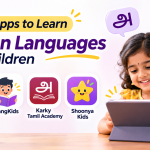
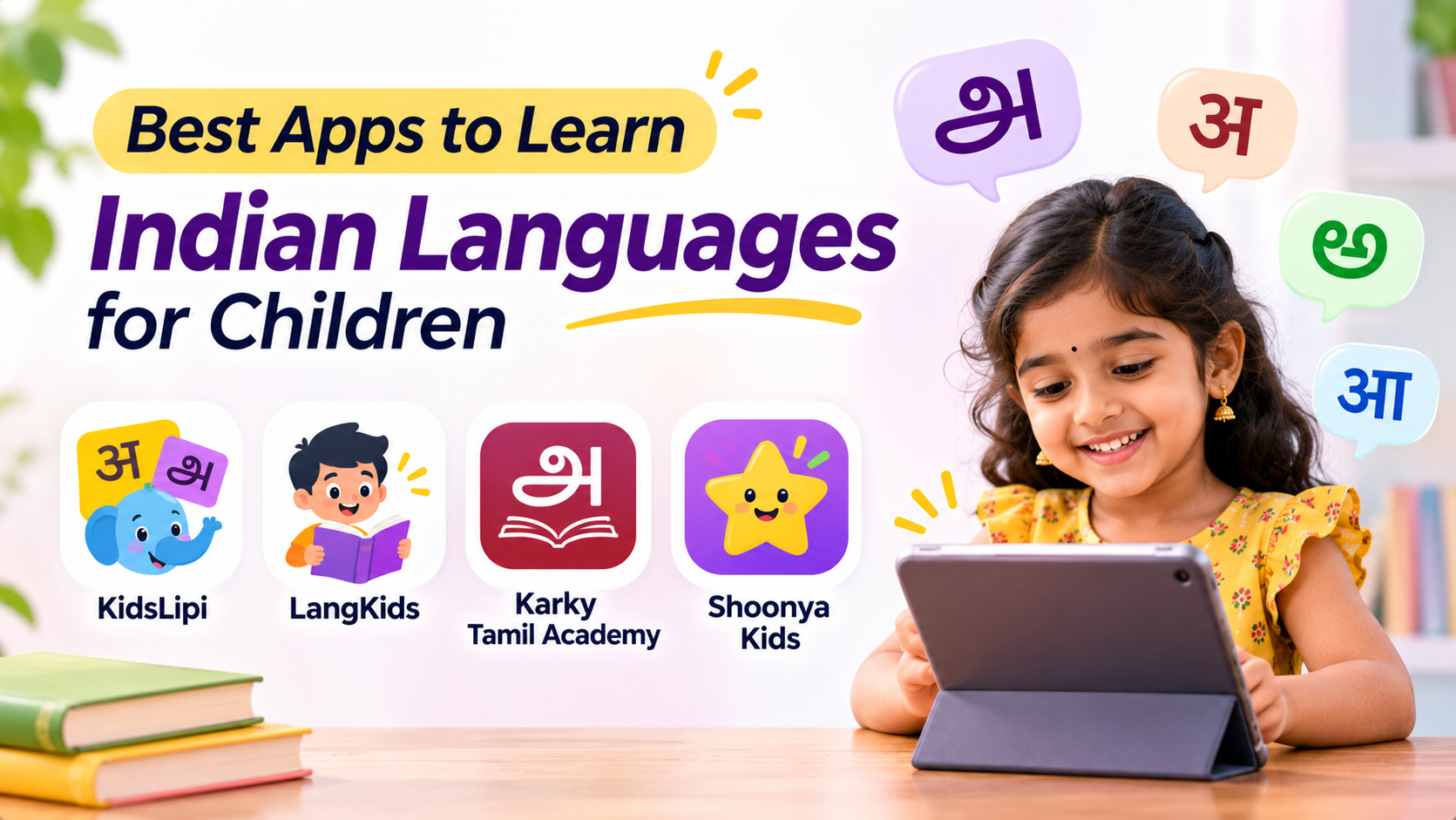
Children who grow up in cities, or abroad, often understand their family’s language but cannot read or write it, and apps have become a popular way to close that gap. The challenge is that most big language apps focus on English, Spanish, and a handful of other global languages, so options for Tamil, Hindi, Marathi, Telugu, and other Indian languages are scattered and uneven in quality. The best apps for young children start with the script, since reading the alphabet unlocks everything else, and then add words, sounds, and short activities. Because many of these apps come from small developers, it is worth checking recent update dates and reading reviews from other parents. App-based learning works best alongside conversation at home, since language is learned mainly by hearing and speaking. Here are four options worth trying.
KidsLipi
KidsLipi is a language learning app for young children covering Hindi, Gujarati, Sanskrit, Telugu, and Tamil, with alphabets and words presented in a colorful, simple format. For non-native speakers, words can also be read in English transliteration, which helps parents who are learning alongside their children. It is free to download on iPhone, and its focus on early scripts and vocabulary makes it a gentle starting point for preschoolers. It is less suited to older children who want structured grammar lessons, and its content is more basic than a full curriculum. For introducing the script and first words in several languages, it is a useful tool.
LangKids: Learn Alphabets
LangKids is an Android app that teaches the alphabets, words, and simple games for six Indian languages in a single app: Hindi, Marathi, Tamil, Telugu, Bengali, and Punjabi. Switching between languages takes a tap, which suits multilingual families and children who are learning more than one script. A recent update, dated August 2026 on its Play Store listing, added word categories such as animals, fruits, colors, and shapes, and a matching game for building memory. It is designed for little hands and short sessions. Depth is limited compared with a full course, but for early reading practice it is a convenient and child-friendly choice.
Karky Tamil Academy
Karky Tamil Academy, which includes the Thambaa Tamil Labs and Payil textbook resources, is aimed specifically at teaching Tamil to children, including those growing up overseas. It offers a more structured approach than a simple alphabet game, with lessons designed around a curriculum rather than isolated activities, and it is built by people focused on Tamil education. It suits families, schools, and weekend Tamil classes that want a progression from letters to reading and writing. Its structured style means it demands more time and parental involvement than a casual app. For parents who want serious, long-term Tamil learning, it is among the more thorough options.
Shoonya Kids
Shoonya Kids is an award-winning iOS app that uses game-based modules to teach early literacy and math, with a focus on culturally inclusive learning in Hindi, Marathi, English, Spanish, and Telugu. It is free to download, and its playful approach appeals to preschool and early primary children. Tamil is not among its listed languages, so Tamil-speaking families will need another app alongside it, and it is available on iOS only. For Hindi, Marathi, and Telugu speakers who want engaging games rather than flashcards, it is a strong candidate.
For older children, Duolingo offers a Hindi course and Language Curry teaches several Indian languages, including Tamil, with a paid plan reported at around 199 rupees a month, though both are better suited to learners from about ten years of age. Choosing among the four apps depends on language and age. Parents of Tamil learners should start with Karky Tamil Academy or LangKids, while Hindi, Marathi, and Telugu families can look at Shoonya Kids and KidsLipi. Combine app time with real conversation, picture books, songs, and family stories in the language, and let children see adults reading it. Ten to fifteen minutes a day is more effective than a long weekly session.
Conclusion
A child who can read the script of their mother tongue has a lasting link to family, literature, and culture, and a good app can make the first steps fun. Pick an app that fits the language and age, check that it is actively updated, and use it as a spark for conversation at home.