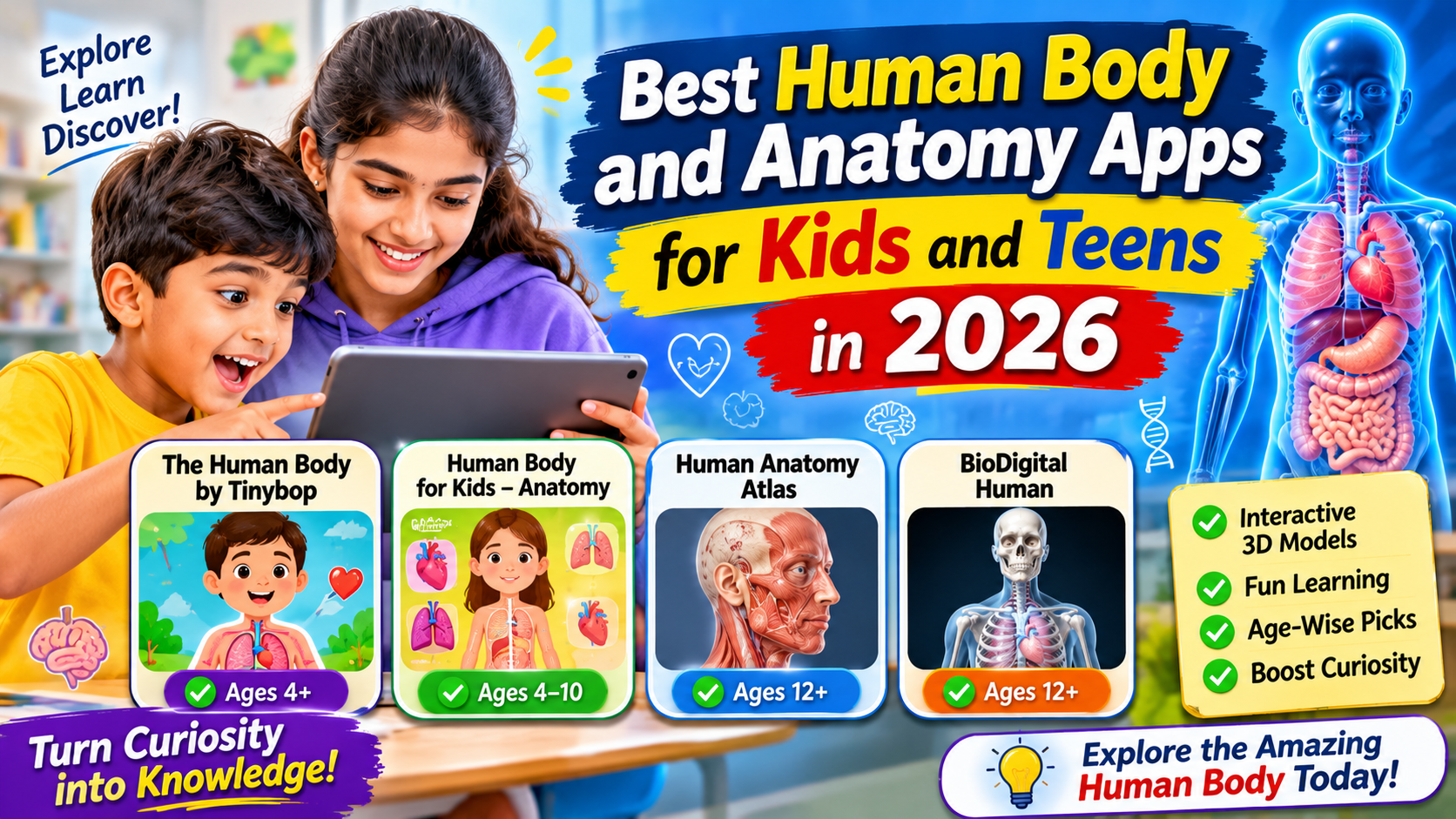
Children ask wonderful questions about their bodies: why does my heart thump, where does food go, how do my eyes see? Interactive anatomy apps answer them far better than a diagram, letting kids watch a heart beat, a stomach churn, or lungs breathe. The apps divide by age. Playful explorers aimed at about four to ten show simplified, animated bodies with little text, while serious 3D atlases built for students and professionals carry detail that will overwhelm young children but suit teenagers. A few apps are paid up front and ad-free, while others are free with in-app purchases or subscriptions, so check the store listing. Most of the best options are iPhone and iPad apps, so Android families may find fewer choices. Apps work best alongside conversation, and sensitive topics should be approached with age-appropriate guidance. Here are four apps.
The Human Body by Tinybop
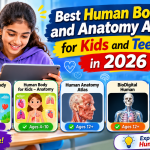
The Human Body by Tinybop is the classic playful anatomy explorer, rated for ages four and up. Children interact with a virtual body: the heart beats, the stomach gurgles, lungs breathe, skin feels, and eyes see, with the skeleton, muscles, brain, and digestion all within reach. It has won awards including a Children’s Technology Review Editor’s Choice, a Parents Magazine Best App for Families, and a Digital Ehon Award, and its listing says no personal data is collected. It is a paid app, listed at about 3.99 dollars, with optional in-app purchases. It is aimed at curious younger children and is iOS-focused. For a first look inside the body, it is the standout.

Human Body for Kids – Anatomy
Human Body for Kids – Anatomy, from Tiny Explorers, is a newer, colorful app that explains how the body works in age-appropriate language and activities, designed for iPad and iPhone and free to download with in-app purchases. It aims at younger children who are just discovering how their bodies work, with simple visuals and activities rather than dense reference. As with many free apps, check what the free version includes and whether purchases or subscriptions are needed. Because it is newer, it has fewer reviews than the established names. For a free way to try anatomy with younger children, it is worth a look.
Human Anatomy Atlas
Human Anatomy Atlas, from Visible Body, is a detailed 3D reference with models of every body system that you can rotate, zoom, and dissect layer by layer, and it is listed at about 25 dollars on iOS. It is aimed at students and is far more detailed than young children need, so it suits teenagers studying biology and anyone curious about real anatomy. It is a reference rather than a game, with little hand-holding. For teens preparing for school biology or a medical career, it is an excellent tool.
BioDigital Human
BioDigital Human is a free-to-start interactive 3D body platform used by students and educators, with models of systems, conditions, and procedures, and an optional paid plan reported at about 10 dollars a month. It is recommended for ages twelve and up, and its detail makes it better for teenagers than for small children. Its content includes health conditions, so parents may want to guide older children through it. It requires some patience to navigate. For teens who want an advanced, interactive exploration of the body, it is among the best.
Complete Anatomy, TeachMe Anatomy, and Anatomix are other apps aimed at older students and professionals. Choosing among the four depends on age. Children aged four to eight should start with Tinybop’s Human Body or another playful explorer, tweens can move on to more detailed content, and teenagers who enjoy biology will get the most from Human Anatomy Atlas or BioDigital Human. Connect screen time to real life: feel your pulse after running, listen to a stomach rumble, or draw an outline of the body and label the organs together. Answer questions about bodies honestly and at the right level, and keep a book or poster nearby for offline learning. Check subscription terms before downloading, and use parental controls for purchases.
Conclusion
Anatomy apps turn a child’s curiosity about their own body into real science learning. Match the app to the age, explore it together, and tie what children see on screen to what they can feel in themselves.