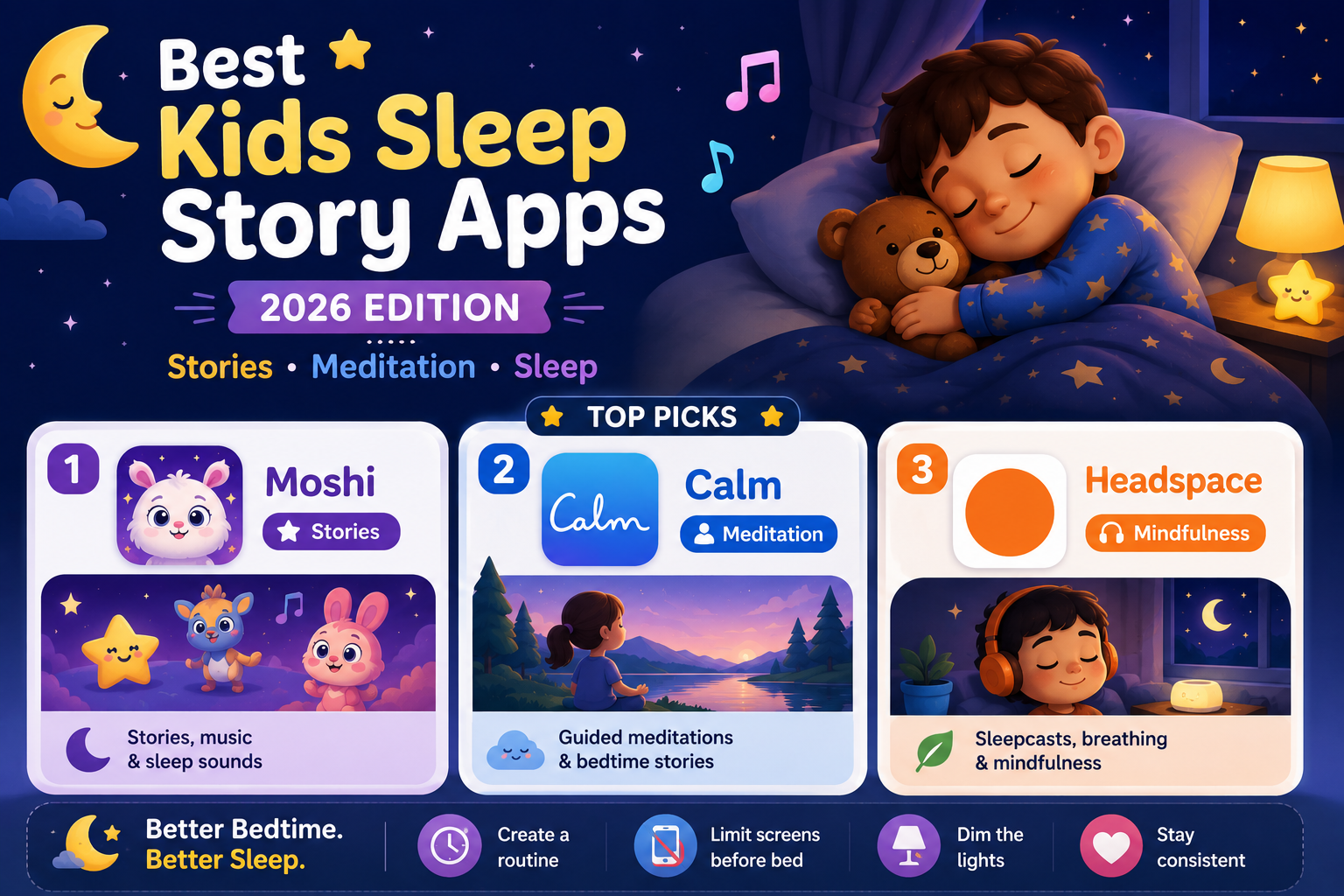
Bedtime resistance is one of the most universal parenting frustrations, and a growing category of sleep story and bedtime meditation apps has emerged specifically to make wind-down time feel less like a battle and more like something a child genuinely looks forward to each night. The strongest apps in this space take meaningfully different approaches: some lean into character-driven storytelling and music, others focus on guided meditation and breathing techniques for kids whose minds simply won’t stop racing at bedtime, and it’s worth matching the app to what’s actually causing the resistance rather than assuming one approach fits every child. Here’s a look at what’s genuinely worth using this year.
Moshi
Moshi has built the longest track record in this category, with a BAFTA award-winning creative team producing hundreds of hours of bedtime stories, white noise, sleep sounds, and lullabies tailored to kids aged newborn through twelve, including special guest content narrated by Goldie Hawn and Patrick Stewart. A study conducted at New York University found Moshi helped children fall asleep an average of 28 minutes earlier and stay asleep 22 minutes longer, giving it genuine research backing beyond marketing claims. Its character-driven storytelling and catchy original music give it a distinctly playful, entertainment-forward feel compared to more meditation-focused apps, which tends to work especially well for younger kids who respond to familiar characters and music more than guided breathing exercises.
Calm
Calm, best known as one of the most popular meditation apps for adults, includes a dedicated Kids section offering yoga, guided meditations, bedtime stories, and breathing exercises designed around a child’s holistic development rather than sleep alone. Its content covers both daytime emotional regulation, teaching techniques like body scanning and tapping for managing big feelings, and nighttime wind-down, giving families a single app that supports a child through more than just the bedtime routine. Because Calm’s kids content sits inside the same broader app used by adults in the household, it works particularly well for families who want a shared meditation and mindfulness resource across every age rather than a separate kids-only app.
Headspace
Headspace built its core reputation on structured guided meditation and habit-building, and its kids-oriented material carries that same emphasis into a bedtime context, focusing on breathing exercises, emotional regulation, and mindfulness skills that a child can genuinely learn to apply over time rather than a passive listening experience alone. Its 45-minute Sleepcasts pair a narrator’s voice with ambient, topic-related sounds like rainfall or wind, and uniquely let users control the volume of the ambient sound independently from the narration itself. The interface is designed primarily for adults with kids’ content tucked into a subsection rather than a dedicated standalone kids app, which makes it a better fit for parents who want to actively teach a child mindfulness skills for the long term rather than simply looking for the richest possible bedtime story library.
Matching the app to the actual source of bedtime resistance tends to matter more than picking the single highest-rated option. For kids who find bedtime boring or resist the routine itself, Moshi’s character-driven, entertainment-forward stories give them something to genuinely look forward to each night. For kids whose minds race with anxious or overactive thoughts at bedtime, Calm or Headspace’s more structured guided breathing and meditation techniques give racing minds something specific to focus on rather than a passive story alone. Many families end up using more than one app depending on the night and what a child specifically needs in that moment, rather than relying on a single tool to solve every kind of bedtime struggle.
Conclusion
Bedtime doesn’t have to be a nightly negotiation, and 2026’s sleep story and meditation apps for kids have gotten genuinely sophisticated at making wind-down time feel calming rather than combative. Whichever of these three ends up being the right fit for a particular child, the underlying goal is the same: replacing bedtime resistance with a routine kids actually want to settle into, night after night.