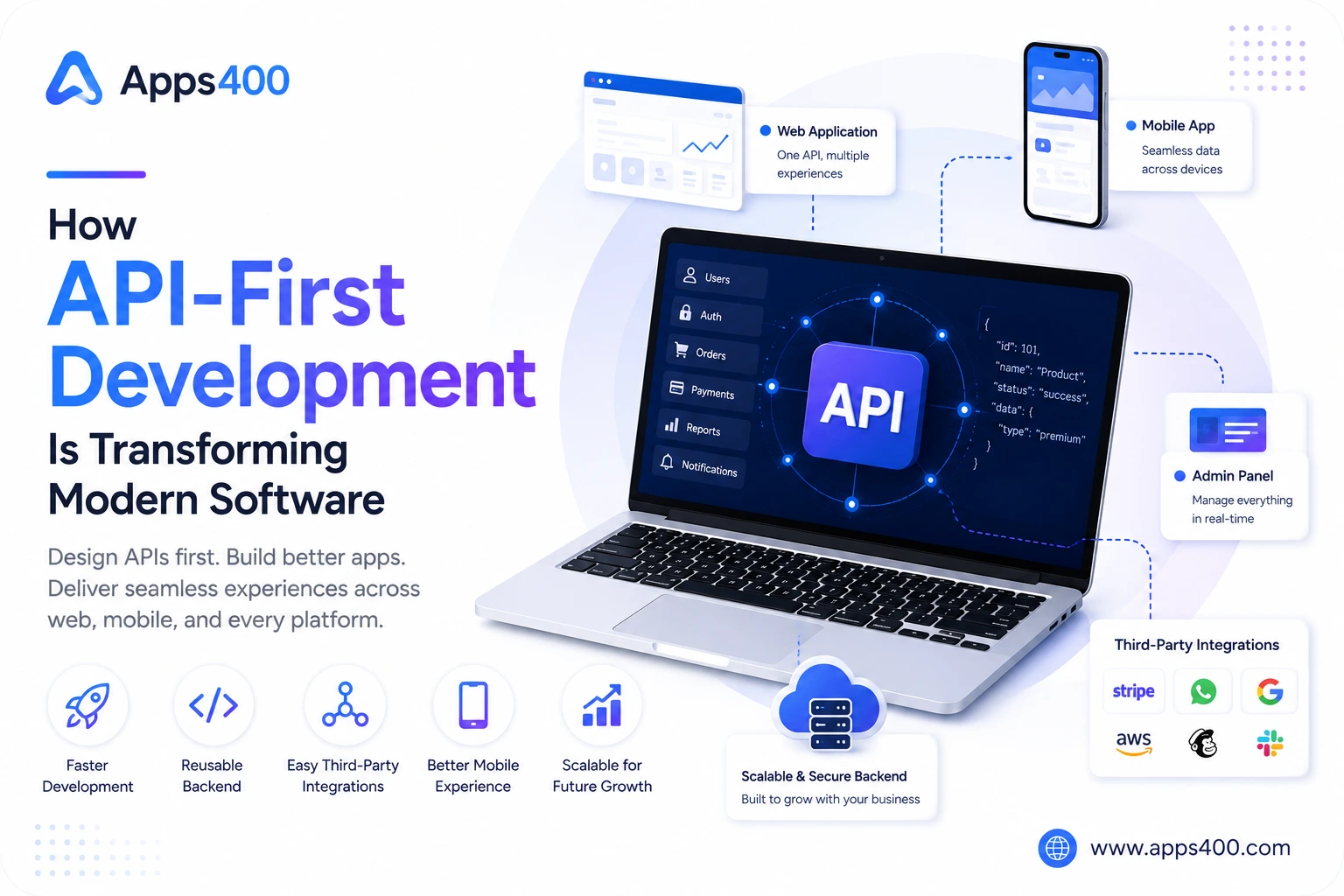
Modern software is no longer built for one screen or one device. A single product may need a website, mobile app, admin panel, customer portal, partner dashboard, chatbot, payment gateway, analytics system, and third-party integrations.
This is why API-first development has become important. API stands for Application Programming Interface. In simple terms, an API allows one software system to communicate with another software system.
Earlier, many teams built the web application first and created APIs later when they needed a mobile app or integration. This often created confusion. The backend was not properly planned. Mobile apps had to adjust to old logic. Third-party integrations became difficult.
In API-first development, the API is planned before or alongside the application interface. The backend becomes the central system. Different apps can connect to it in a clean and structured way.
For startups, indie developers, software companies, and internet entrepreneurs, this approach can save time, reduce duplication, and support future growth.
What Is API-First Development?
API-first development means the software system is designed around APIs from the beginning. Before building screens, the team thinks about the data, business logic, user actions, permissions, and communication between systems.
For example, if a startup is building a task management app, the API may include endpoints for users, projects, tasks, comments, attachments, notifications, and reports.
The web app, mobile app, and admin panel can all use the same API. This avoids creating separate logic for each platform.
API-first development is not only a coding method. It is also a planning method. It helps teams clearly define how the software will work before building too many frontend screens.
Why APIs Are Important in Modern Apps
Today, most software products need to connect with other systems. A SaaS product may connect with payment gateways, email services, SMS providers, CRM tools, analytics platforms, AI APIs, cloud storage, and authentication services.
Without a proper API structure, these connections become difficult to manage.
APIs also make it easier to build multiple user interfaces. For example, a business may need a customer-facing app, a staff mobile app, and an internal admin dashboard. All of them can use the same backend if the API is well-designed.
This makes the product more flexible. The company can add new platforms later without rebuilding the entire system.
Faster Development for Multiple Teams
API-first development helps frontend and backend teams work in parallel.
In a traditional approach, frontend developers may wait for backend development to finish before connecting screens to real data. This can slow down the project.
In an API-first approach, the team can define the API contract early. The frontend team can build screens using sample responses, while the backend team builds the actual logic. Once the API is ready, both sides can connect more smoothly.
This is useful for software companies handling client projects. It improves planning, reduces confusion, and helps deliver products faster.
For startup founders, faster development means quicker launch and faster user feedback.
Better Mobile App Development
Mobile apps need a reliable backend. If the API is not designed properly, the mobile app may become slow, unstable, or difficult to update.
API-first development helps mobile apps receive exactly the data they need. It also supports features like login, notifications, profile updates, file uploads, location tracking, payment processing, and real-time updates.
For example, a field service app may have a web admin panel for managers and a mobile app for agents. The admin can assign tasks from the web dashboard, while agents can update task status from the mobile app. Both systems communicate through the same API.
This creates a smooth connection between different users and devices.
Easier Third-Party Integrations
Modern software often depends on third-party services. Payment gateways, WhatsApp messaging, Google Maps, email platforms, accounting tools, and AI services are common examples.
An API-first system makes integrations easier because the application already follows a structured communication model.
For example, a healthcare software platform may need to integrate appointment reminders, lab reports, billing systems, patient portals, and medical devices. These integrations require careful API planning. Businesses developing such platforms often work with a specialized healthcare software development company to build secure and scalable healthcare applications with proper integration support.
Good APIs help software products become part of a larger digital ecosystem.
Reusable Backend Logic
One of the biggest advantages of API-first development is reusability. The same backend logic can serve multiple applications.
For example, user authentication can be used by the website, mobile app, and admin panel. Reporting APIs can be used by dashboards and export tools. Notification APIs can be used by both web and mobile users.
This reduces duplicate work. It also makes maintenance easier. If the business logic needs to change, the team can update it in one place instead of changing multiple systems separately.
For growing startups, this is very useful. As the product expands, the backend remains organized and reusable.
Better Security and Access Control
Security is an important part of API-first development. Since APIs expose data and actions, they must be protected properly.
A secure API should include authentication, authorization, validation, rate limiting, logging, and error handling. Users should only access the data and actions they are allowed to use.
Role-based access control becomes easier when APIs are planned properly. For example, an admin may access user management APIs, while a normal user may access only their own profile and records.
APIs should also avoid exposing unnecessary data. The response should be clean, limited, and relevant to the request.
Good API security protects both the application and the users.
API Documentation Improves Collaboration
API documentation is very important in modern software development. It explains how each API works, what data it accepts, what response it returns, and what errors may occur.
Tools like Swagger or OpenAPI are commonly used to document APIs. This helps frontend developers, mobile developers, QA testers, and third-party partners understand the system.
For client projects, API documentation also improves transparency. The client can see how the system is structured and how future integrations can be built.
Well-documented APIs reduce dependency on one developer. Even if team members change, the project can continue more smoothly.
API-First Supports Future Growth
A product may start with one web app. Later, the founder may want to add a mobile app, partner portal, public API, AI assistant, or automation engine.
If the backend was built with API-first thinking, adding these features becomes easier.
For example, a SaaS product may first launch as a web dashboard. Later, it may add a mobile app for users. After that, it may offer API access to enterprise customers. With good API planning, the product can grow step by step.
This is why API-first development is not only useful for today’s requirements. It prepares the product for future possibilities.
Common Mistakes in API Development
API-first development is powerful, but it must be done carefully. Some teams create APIs without proper structure. This can create confusion later.
Common mistakes include unclear endpoint names, inconsistent response formats, weak validation, missing documentation, poor error messages, and no versioning.
Another mistake is exposing too much data in API responses. This can create security and performance problems.
A good API should be simple, predictable, and consistent. Developers should be able to understand and use it without confusion.
Conclusion
API-first development is transforming modern software because it helps products become more flexible, scalable, and integration-ready. It allows web apps, mobile apps, admin panels, and third-party systems to connect through one organized backend.
For startups, indie developers, software companies, and internet entrepreneurs, this approach can improve development speed, reduce duplication, and support long-term growth.
Every software idea has the potential to become more than one app. It may grow into a platform, ecosystem, or SaaS product. When the foundation is built with strong API-first thinking, that idea can turn into software that is easier to expand, easier to maintain, and more valuable for users.